Table of Content

Functional Improvements

Multi-currency account support for FX payments

The platform now supports foreign exchange payments from multi-currency accounts through enhanced MT101 file generation and bulk payment upload capabilities. Users can specify which currency line to use when making FX payments from accounts that maintain multiple currencies under the same IBAN.

Bulk payment uploads via CSV, Excel and pain.001 files support two additional optional fields: Ordering Party Account Currency and Ordering Party BIC. These fields enable unique identification of ordering accounts when multiple currency lines or BIC codes share the same IBAN. The platform validates ordering accounts using IBAN, BIC and currency parameters together, ensuring users can create bulk payments from multi-currency accounts with precise control over which account line processes each payment.

UI and UX improvements and small enhancements

The platform includes stability improvements for bulk payment processing and signatory rule management. Large payment file processing now uses atomic write operations to prevent file corruption during simultaneous read and write operations. Signatory rule gap calculation has been corrected to display all missing rule combinations on the first calculation. Various refinements enhance overall system reliability.

Table of Content

Functional Improvements

Immediate payment submission

Authorised SEPA payments are now sent directly to the bank without waiting for batch processing windows, eliminating cut-off time delays.

The system automatically adjusts weekend and holiday execution dates to the next banking day, ensuring prompt submission while respecting banking calendars.

Enhanced payment reconciliation

The platform now processes pain.002 status report files (ISO 20022 standard) to provide intermediate payment status updates before final settlement. Banks send these files to confirm receipt, acceptance, or rejection of payment instructions.

When a bank accepts a payment, the status updates to "Executed." Rejected payments display as "Not executed" with the rejection reason. This real-time feedback enables users to monitor payment progress and address issues before end-of-day settlement for all payment types.

Further details about this feature, including screen descriptions, will be available in the User guide

Flexible approval workflow

Tenant settings approvals now require one or two signatures based on who made changes, maintaining the four-eyes principle. When a single administrator makes all changes, a second administrator must approve. When multiple administrators contribute changes, the system accepts one signature from an uninvolved administrator or two signatures from contributors.

The platform displays which administrators contributed with changes and shows approval requirements through contextual warnings and confirmation dialogs. The audit log records all approval actions for complete authorisation history.

Further details about this feature, including screen descriptions, will be available in the User guide

Permission editing

Administrators can now edit user and user group permissions directly without deleting and recreating entries. The edit interface allows adjustments to permission scopes, parameter values and access levels on user details and user groups details pages.

This eliminates the previous workflow where administrators had to identify, delete and manually recreate entire permission structures for each modification.

Further details about this feature, including screen descriptions, will be available in the User guide

UI and UX improvements and small enhancements

The platform's bank connectivity has been migrated to the EBICS API standard, improving reliability and performance of bank communication channels. Various refinements enhance overall system stability and user experience.

Table of Content

Functional Improvements

Counterparty groups management

In addition to the previous release, version 6.3.1 introduces counterparty group management in the user interface. This enhancement gives users greater flexibility to organize counterparties in groups either during the creation process or at a later stage. A review step has also been added to manage the removal or addition of counterparties within existing or new groups.

Counterparty group management further strengthens granular permission controls for user access and signatory rules, building on features delivered in earlier releases.

Improvements and small enhancements

Small generic improvements have been made to improve the performance and the user experience on the application.

Table of Content

Functional Improvements

Tenant Settings Approval

Managing tenant settings—such as the signatory matrix and user management—is essential for daily operations. To enhance security and control, we have introduced the Tenant Settings Approval feature.

This feature adds an extra layer of security by requiring a second person to review and approve any changes before they take effect in the LYNKS application. This helps minimize risk by ensuring all administrator actions are double-checked.

You can request to enable this feature in your environment by contacting Finologee's customer support. Further details on this feature will be soon available in the LYNKS user guide.

Improvements and small enhancements

We’ve made several small updates to improve performance and user experience, including:

  • Enhanced validations
  • Naming for signatory rules
  • A smoother onboarding process in the LYNKS mobile app
  • Faster data loading and display

Bug Fixes:

Resolved a bug that prevented transactions between ordering party accounts from being correctly reconciled.

Table of Content

Functional Improvements

Depositary oversight workflow

A new oversight workflow has been introduced to support depositaries, enabling payment instructions initiated in a different tenant to be approved or rejected. This functionality allows for a clear separation of duties and facilitates compliance in scenarios where payment initiation and oversight are handled by distinct entities. Learn more here.

Counterparty permission scoping

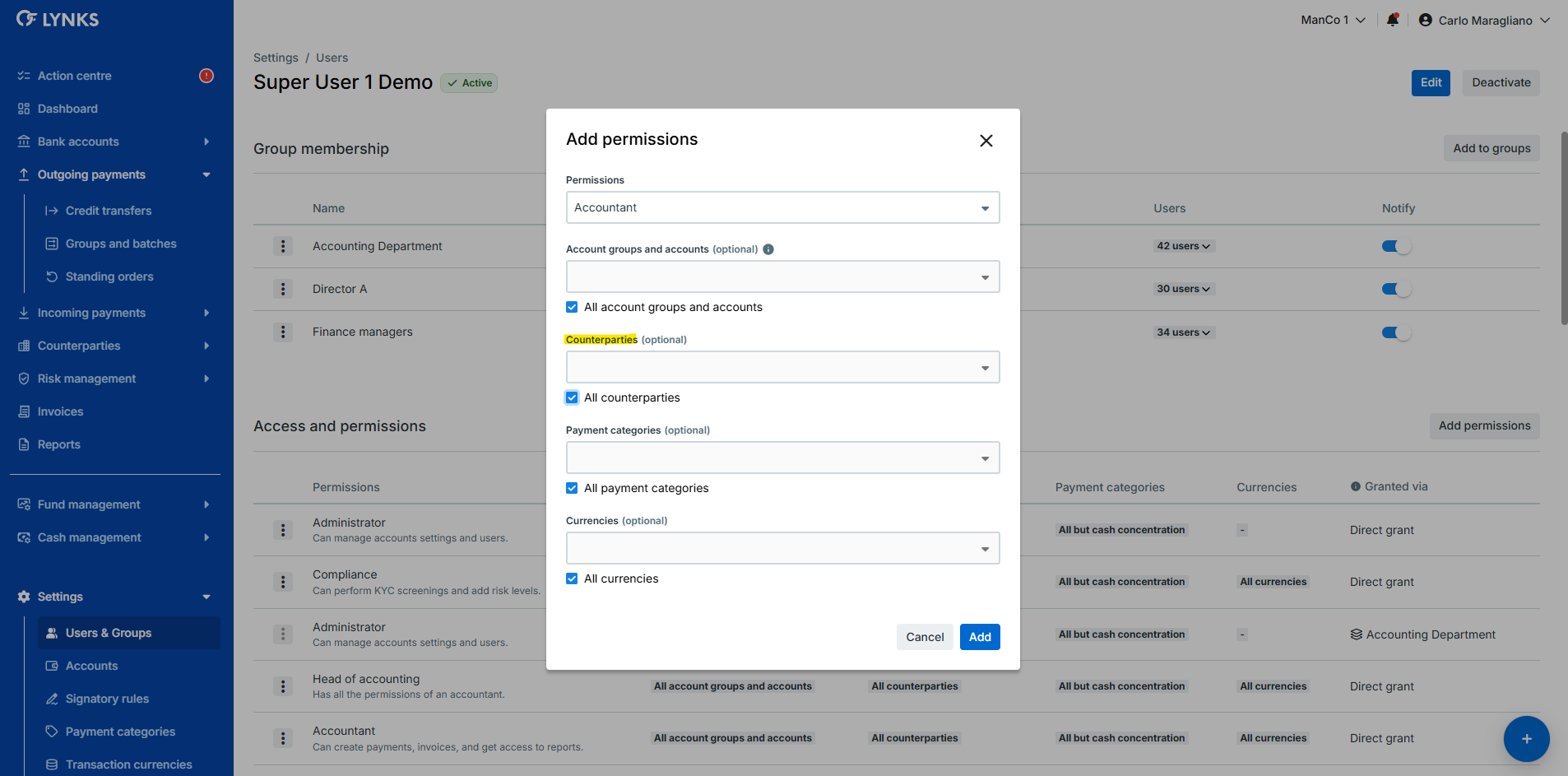
A new counterparty scoping feature is now available, enabling administrators to control which counterparties are visible to each user. The functionality mirrors the existing scoping logic for ordering party accounts, and now extends segregation of access to include target (counterparty) accounts as well as source accounts. The enhanced control improves data confidentiality and supports more precise user access configurations across the platform.

User permission scoping on counterparties

Auto-approve and auto-reject signatory rules

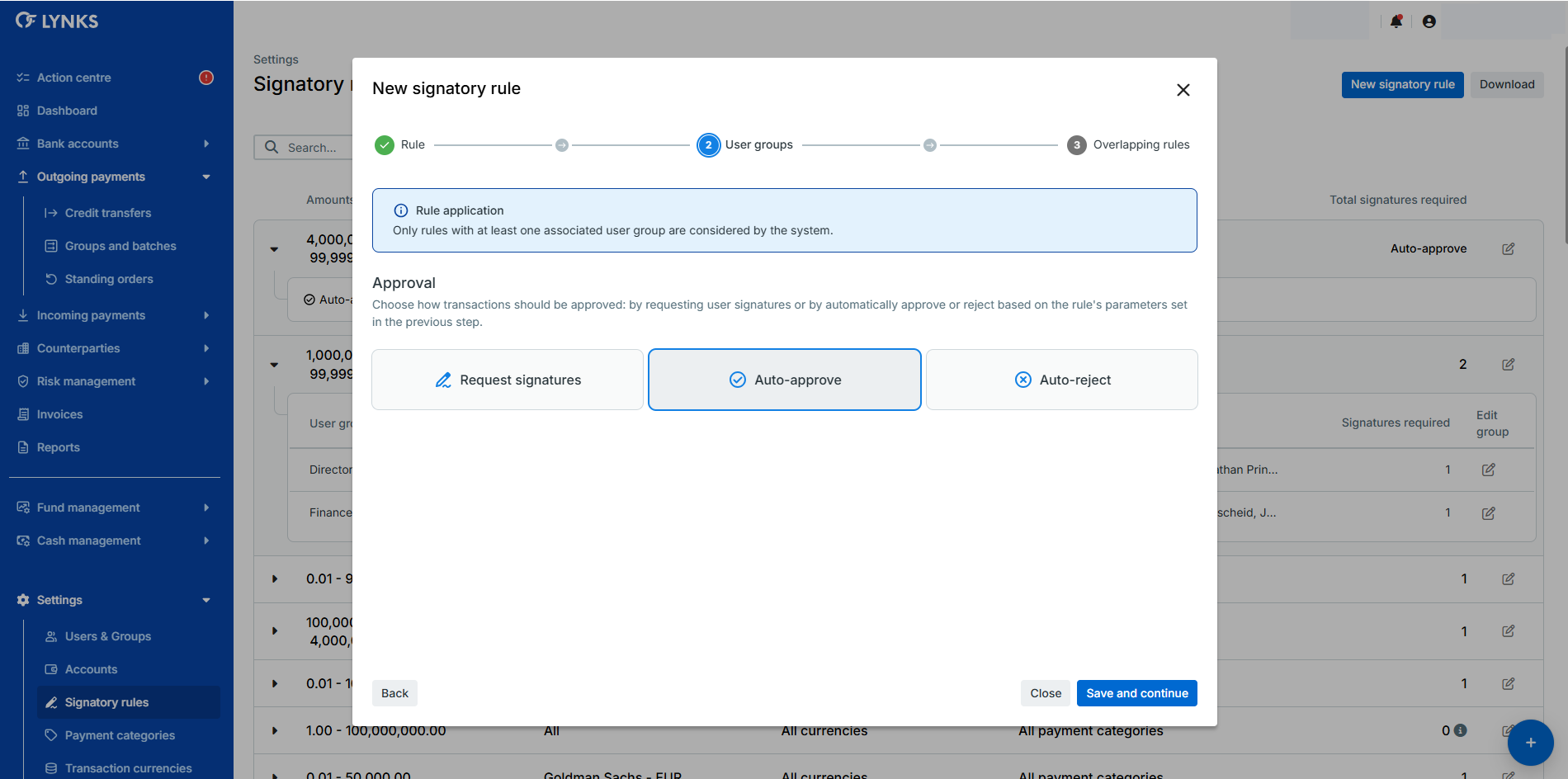
The signatory rule framework has been extended to cover payment flows that don’t require user signatures. Payments can now be automatically approved or rejected based on predefined rule logic. This enhancement streamlines the processing of small payments and ensures that every payment is subject to governance controls and auditability, even if no specific business case supports them.

Auto-approve and auto-reject signatory rules

UI and UX improvements and small enhancements

Various refinements across the platform to ensure a more intuitive and user-friendly interface. Enhancements included a thorough review of labels, pagination and more.

Improved user interface

Table of Content

Functional Improvements

Securities reporting

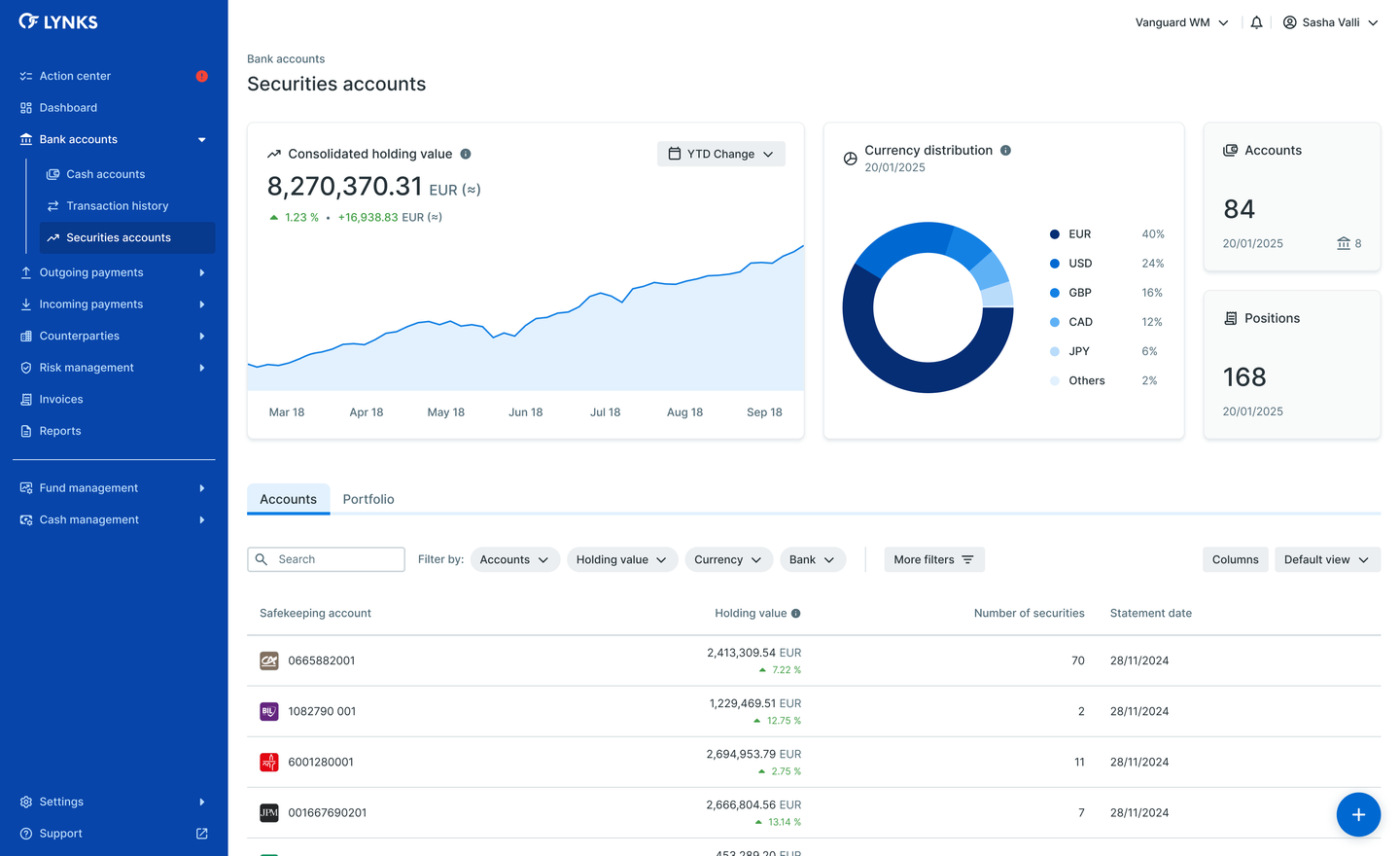
The Securities Reporting feature in the LYNKS application enables users to integrate and manage their securities accounts alongside their cash accounts. This enhancement allows for a comprehensive view of global positions, combining cash and securities data on a single platform.
With this feature, users can:

  • Monitor the overall status of their investment portfolio
  • Track each security held, per account or in a consolidated view
  • Safekeep individual accounts
  • Monitor the evolution of the total portfolio value
  • Analyze risk distribution by currency

This unified overview supports users in making informed investment decisions and planning their next steps effectively.

Additionally, securities account reports provided by the bank are available directly within the interface, offering deeper insights, analysis, and consolidation.

Detailed information about this feature, including screen descriptions, will be available in the User guide

User provisioning

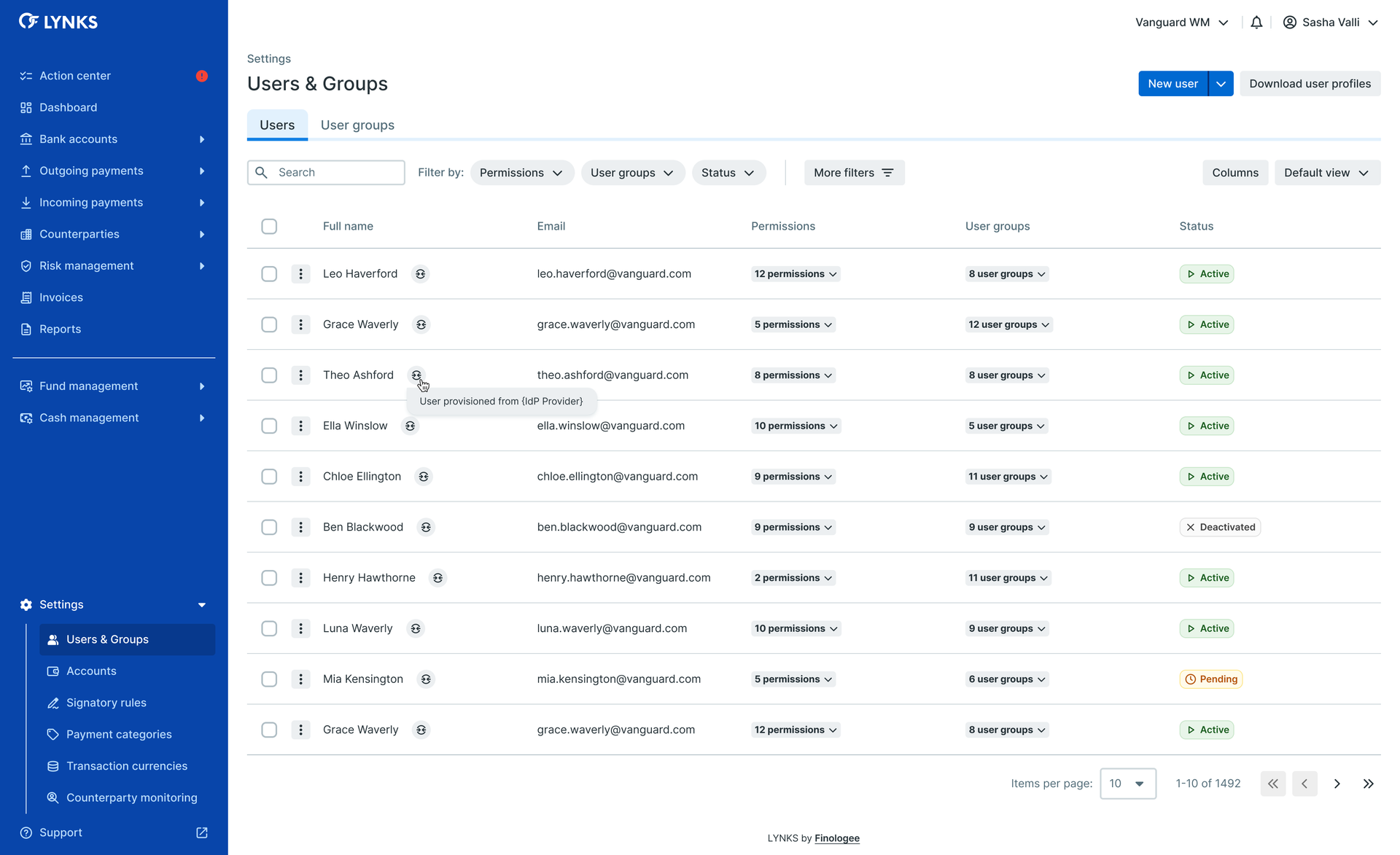
The LYNKS application now supports user provisioning via the SCIM protocol (System for Cross-domain Identity Management). This feature enables organizations to centrally manage users by connecting their external user directory directly to LYNKS. With SCIM integration, any changes made in your identity provider—such as adding, updating, or removing users and groups—are automatically reflected in LYNKS.

Further details about this feature, along with screen descriptions and setup instructions, will be published in the User guide

Webhooks - workflow automation

The Webhooks feature lets your application automatically respond to key events within your API integration. By subscribing to events like payment status updates or new statements, your system can receive instant, real-time notifications as soon as they happen.

Further details of the feature and descriptions of the related screens will be published in the User guide

UI and UX Improvements and Small Enhancements

We’ve improved the application’s performance by fixing various bugs and addressing minor UI issues, resulting in a smoother and more reliable user experience. Additionally, we’ve made small enhancements such as updated icons, better readability, and more intuitive color coding to distinguish negative and positive feedbacks.

Minor improvements and bug fixes

Optimized the reconciliation algorithm for Direct Debits and resolved various bugs to enhance the overall user experience.

Table of Content

New Features and Improvements

Cash concentration

We’re excited to introduce cash concentration, a new cash management automation feature in the LYNKS application. With customizable rules, users can now define upper and lower thresholds to maintain target balances or transfer excess cash between accounts. This enhancement improves the treasury management capabilities of LYNKS by automating payment workflows and optimizing the management of cash surpluses.

Cash concentration functionality

LYNKS mobile app

We are rebranding the FinologeeSIGN mobile application to LYNKS Mobile App, bringing it in line with the LYNKS ecosystem. This update goes beyond a simple name change—it introduces a refined user experience with enhanced security and usability.

With a fresh, modernized design, the app now provides a more intuitive interface, making navigation smoother and interactions more efficient. Security remains a top priority, with reinforced authentication mechanisms and optimized data protection features. These improvements ensure that users can confidently manage their operations within a seamless and highly secure mobile environment.

Table of Content

Functional Improvements

Direct Debits

The new SEPA Direct Debit (SDD) feature enables fee collection in the LYNKS application, supporting both recurring as well as one-time direct debits. The implementation covers the complete direct debit flow (from LYNKS to the bank and back). The SDD batch is sent to the bank and its status is updated upon receiving the bank's feedback (in the form of PAIN.002 file). This new feature, which can be made available upon request, enables the creation of direct debits exclusively via the external API.

Further details of the feature and descriptions of the related screens will be published in the User guide